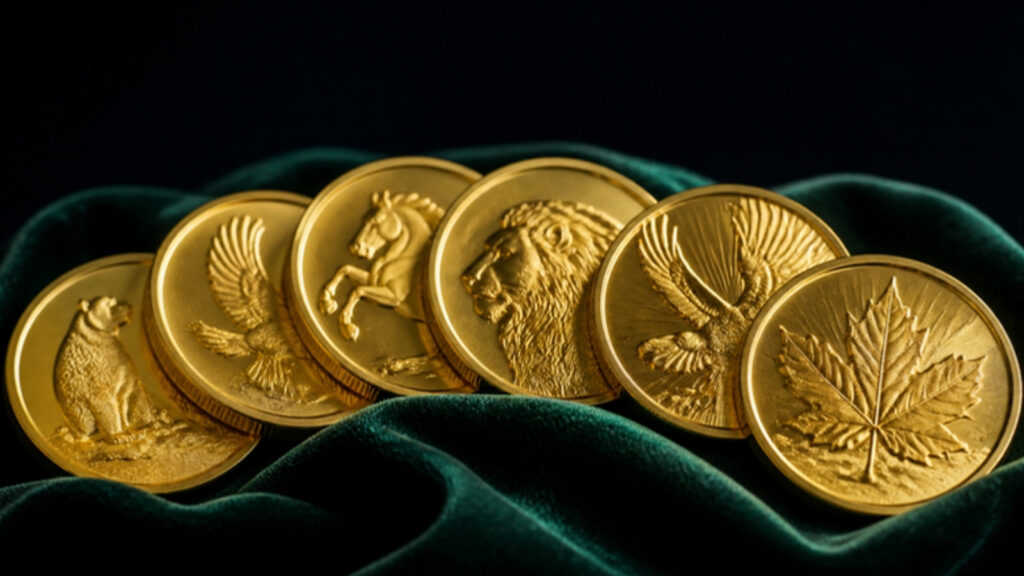
For US investors, the most widely traded gold bullion coins are the American Gold Eagle, the American Gold Buffalo and the Canadian Gold Maple Leaf. All three contain one troy ounce of gold in their 1 oz size, so the best value on any given day is usually the one with the lowest premium over spot and the strongest dealer buy-back price. Fractional coins cost more per ounce but let you buy and sell in smaller amounts.
How to judge value in a gold coin
Compare coins on what you pay for the gold, not on the sticker price alone:
- Premium over spot – the coin’s price minus the value of its gold, as a percentage.
- Dealer bid (buy-back) – what dealers pay for the same coin today. Popular coins often have bids close to or above spot.
- Spread – the gap between ask and bid, which shows the round-trip cost.
- Payment method – most dealers charge more for card or PayPal than for wire, ACH or check.
For federal income tax, all three coins are treated the same way: the IRS classifies physical gold as a collectible, with long-term gains taxed at a maximum rate of 28% and short-term gains as ordinary income.
The coins at a glance
| Coin | Mint | Fineness | Gold content | Sizes |
|---|---|---|---|---|
| American Gold Eagle | U.S. Mint (since 1986) | 22 karat (.9167) | 1 troy oz in the 1 oz coin | 1, 1/2, 1/4, 1/10 oz |
| American Gold Buffalo | U.S. Mint (since 2006) | .9999 (24 karat) | 1 troy oz | 1 oz |
| Canadian Gold Maple Leaf | Royal Canadian Mint (since 1979) | .9999 | 1 troy oz in the 1 oz coin | 1 oz and fractions |
American Gold Eagle
The Gold Eagle is the official US gold bullion coin. It is 22 karat, alloyed with silver and copper for durability, so the 1 oz coin weighs about 33.93 grams while containing exactly one troy ounce of gold. It is recognized by virtually every US dealer and coin shop, and it is specifically named in the tax code as eligible for IRAs despite its 22-karat fineness. Gold Eagles are generally not on the list of products that trigger Form 1099-B reporting when sold to a dealer.
American Gold Buffalo
The Buffalo was the first 24-karat gold coin struck by the U.S. Mint. Its design is based on the classic Buffalo nickel. It is .9999 fine, which makes it softer than the Eagle and more prone to scratches; dealers may pay less for coins with visible marks. Its premium is often similar to, or a little above, the Eagle’s.
Canadian Gold Maple Leaf
The Maple Leaf is struck by the Royal Canadian Mint in .9999 fine gold and includes security features such as radial lines and a micro-engraved mark. It is widely traded in the US and its premium is sometimes lower than US coins. Note that 1 oz Maple Leafs are among the products commonly cited as reportable on Form 1099-B when 25 or more are sold to a dealer in one transaction; any gain is taxable either way.
Illustrative cost comparison
Illustrative prices only (not current), with spot at $4,000 per ounce:
| Product | Gold content | Example ask | Premium | Example bid |
|---|---|---|---|---|
| 1 oz Gold Eagle | 1 oz | $4,240 | 6.0% | $4,040 |
| 1 oz Gold Buffalo | 1 oz | $4,260 | 6.5% | $4,040 |
| 1 oz Maple Leaf | 1 oz | $4,180 | 4.5% | $4,000 |
| 1/10 oz Gold Eagle | 0.1 oz | $460 | 15.0% | $410 |
| 1 oz gold bar (for comparison) | 1 oz | $4,120 | 3.0% | $3,980 |
In this example the Maple Leaf has the lowest premium of the three coins, while a 1 oz bar is cheaper still. The Eagle’s bid partly offsets its higher ask. Real premiums change with demand and differ between dealers, so compare live quotes on our US gold prices page.
Matching the coin to the purchase
- Lowest premium per ounce: 1 oz coins, compared on the day; or bars if you do not need a coin.
- Small budgets or regular buying: fractional Eagles or Maple Leafs, accepting a much higher premium per ounce.
- Durability: the 22-karat Eagle resists scratches better than .9999 coins.
- IRA: Eagles are named in the law; .9999 coins like the Buffalo and Maple Leaf are generally accepted by IRA custodians on fineness. Coins must be held by the IRA trustee or custodian.
Buy-back and liquidity
All three coins are easy to sell in the US. Dealers usually pay the most for coins in good condition, in original tubes or packaging, and for the most familiar products. Examples of US dealers include Hero Bullion, SD Bullion, BGASC, Silver.com, Summit Metals, Gainesville Coins and Texas Precious Metals; see our US bullion dealers page. When selling, compare bids across several dealers; you do not have to sell back where you bought.
Pitfalls to avoid
- Paying proof or “rare date” prices when your goal is gold content.
- Comparing card prices with wire prices across dealers.
- Forgetting shipping, insurance and state sales tax on small orders.
- Handling .9999 coins without protection.
Our gold calculator converts weight and purity into current metal value.
Bottom line
The Gold Eagle, Gold Buffalo and Maple Leaf each contain one troy ounce of gold in their 1 oz size. Value comes down to the day’s premium, the dealer’s bid and the payment method. 1 oz coins cost less per ounce than fractional coins, and bars usually cost less than coins.
Sources: U.S. Mint · Royal Canadian Mint · IRS – Topic 409 · World Gold Council
This is general information, not tax or investment advice.
Frequently asked questions
Which gold coin has the lowest premium?
It changes with demand and by dealer. Among 1 oz coins, the Maple Leaf and Gold Eagle often have competitive premiums, while fractional coins cost much more per ounce.
Is the Gold Eagle pure gold?
No. It is 22 karat (.9167 fine), alloyed with silver and copper, but the 1 oz coin still contains exactly one troy ounce of gold.
Are Gold Buffaloes and Maple Leafs IRA eligible?
Both are .9999 fine and are generally accepted by IRA custodians. The Gold Eagle is named in the tax code. IRA coins must be held by a trustee or custodian.
Are gold coins taxed differently from bars?
No. For federal income tax both are collectibles: long-term gains are taxed at a maximum of 28% and short-term gains as ordinary income.