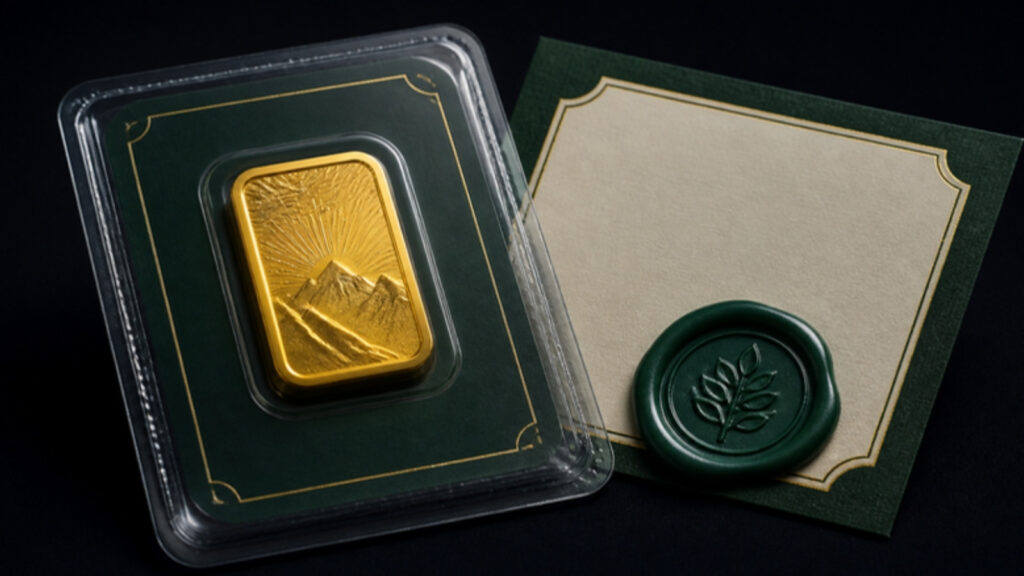
A gold bar should carry stamped markings showing the refiner, weight, fineness and usually a unique serial number. Smaller bars typically come sealed in a tamper-evident assay card, and the dealer should give you an invoice. None of this makes the gold worth more, but it makes the bar easier to verify, insure and sell.
What should be stamped on the bar itself
The most important information is on the metal, because packaging can be lost. Look for:
- Refiner’s name or logo – for example The Royal Mint, PAMP, Valcambi, Argor-Heraeus, Heraeus, Umicore or Metalor.
- Weight – in grams or troy ounces, such as “100 g” or “1 oz”.
- Fineness – usually “999.9” (Fine Gold 999.9). To count as VAT-free investment gold in the UK, a bar must be at least 995 fine.
- Serial number – found on most bars above a few grams. It should match the number on the assay card and, ideally, on your invoice.
- Assayer’s mark – some bars also carry the word “Assayer” or a similar mark confirming the metal was tested.
There are two main types of bar. Cast bars are poured into moulds, have a slightly rough surface and stamped lettering, and are often sold loose with a paper certificate. Minted bars are cut from rolled gold and struck, giving a smooth, shiny surface and a design; they are almost always supplied in a sealed card.
What an assay card is and what it shows
An assay card is a credit-card-sized (or slightly larger) card with the bar sealed in a clear plastic blister. It usually shows:
- the refiner’s name and logo;
- the bar’s weight, fineness and serial number;
- the signature of the assayer;
- security features such as a hologram, micro-text or special printing.
Some refiners add extra verification. PAMP, for example, has a smartphone app that recognises the surface of certain minted bars, and others print QR codes or let you check a serial number online.
An important caveat: assay cards are counterfeited too. The card is an additional assurance, not proof on its own. Buying from an established dealer remains the strongest protection.
Paperwork you should get from the dealer
| Document | Why it matters |
|---|---|
| VAT invoice or receipt | Proves the purchase, price and date. For investment gold it should show that no VAT was charged. |
| Assay card or certificate | Confirms the bar’s origin, weight and fineness. |
| Serial number on the invoice (where given) | Links that specific bar to your purchase. |
| Buy-back terms (if offered) | Shows the conditions on which the dealer will buy the bar back. |
In the UK, supplies of investment gold are exempt from VAT under VAT Notice 701/21: bars and wafers of at least 995 fineness, plus qualifying coins. The invoice also matters for tax later. Gold bars are chargeable assets for Capital Gains Tax, so the purchase price on your invoice is part of how any gain is worked out. UK legal tender coins such as Sovereigns and Britannias are treated differently and are generally exempt from CGT.
Should you open the packaging?
The sealed card protects the bar from scratches and fingerprints. Opening it does not reduce the value of the gold itself. When you sell, however, a dealer may want to test a bar that is out of its original seal, and some pay a little less for bars without packaging or with visible marks. That is why many owners keep bars sealed.
For cast bars sold without a card, keep the certificate and invoice somewhere dry and separate from the gold, and photograph them as a backup.
Do gold coins come with a certificate?
Bullion coins such as the Britannia, Sovereign and Krugerrand are normally sold without an individual certificate. Their specifications are fixed and published by the mint, and they come in capsules or in tubes of several coins. Certificates are usually supplied only with proof and other collector coins, or with coins graded by an independent grading service. You can compare coin prices on our UK gold prices page.
Why the refiner matters
The London Bullion Market Association (LBMA) maintains the Good Delivery List of refiners whose large bars are accepted on the wholesale market. To join it, a refiner must pass checks on its assaying accuracy and responsible sourcing. The list applies directly to large bars of about 400 oz, but most of these refiners also make small bars for private buyers.
A bar from a well-known refiner is easier for buyers to recognise, which often means a quicker sale and a narrower gap between buying and selling prices. Bars from unknown makers are not necessarily fake, but dealers tend to test them more thoroughly. You can compare dealers on our UK bullion dealers page.
A quick checklist when your bar arrives
- Does the serial number on the bar match the card and the invoice?
- Is the packaging intact, with no signs of tampering or pressure marks?
- Do the weight and fineness match on the bar, the card and the invoice?
- Do the printing and hologram on the card look sharp and professional?
- Does the invoice show the dealer’s name and address, date, description and price?
If anything does not match, contact the dealer before doing anything else. When buying by post, film the unboxing so you have evidence if there is a problem. Keep a separate note of all serial numbers; it helps with insurance claims, theft reports and future sales.
What if you lose the certificate?
The bar is still the same gold. When you sell, the dealer may ask to test it or may offer a slightly lower price. If the bar comes from a recognised refiner and its markings are clear, this is usually a minor issue, and an invoice showing the serial number helps.
Bottom line
A gold bar should be stamped with the refiner, weight, fineness and usually a serial number. The assay card and invoice confirm its origin and your purchase, but cards can be faked too. Bullion coins normally come without certificates. Sealed bars from recognised refiners are generally the easiest to sell.
Sources: LBMA – Good Delivery List (gold) · LBMA – About Good Delivery · HMRC – VAT Notice 701/21: gold
This is general information, not tax or investment advice.
Frequently asked questions
What is an assay card?
A sealed card holding a bar, showing the refiner, weight, fineness and serial number, often signed by the assayer and protected with a hologram.
Does opening the packaging reduce a bar's value?
The gold keeps its value, but a dealer may want to test an unsealed bar and some pay slightly less for bars without packaging or with marks.
Do gold coins come with certificates?
Bullion coins usually do not. Their specifications are set by the mint. Certificates normally come only with proof or graded collector coins.
Why should I keep the invoice for gold bars?
It proves the purchase price and date. Gold bars are chargeable assets for Capital Gains Tax in the UK, so the cost matters when working out any gain.